You don’t need a coffee machine to brew a seriously good cup. Brewing coffee without a machine is simple, surprisingly enjoyable, and — done right — capable of producing results that outperform an automatic drip brewer. Here are seven proven methods, from the simplest campfire-ready technique to a 24-hour approach that rewards your patience with the smoothest coffee you’ve ever tasted.
According to the National Coffee Association, around 66% of Americans drink coffee every day. Plenty of those cups are brewed by hand — and many coffee professionals who taste and evaluate coffee for a living actively prefer manual methods for the control and flavour clarity they deliver over automated machines.
Key Takeaways
- Seven reliable methods let you brew quality coffee with no electrical equipment at all.
- Most techniques require only hot water, ground coffee, and something basic to filter with.
- Water temperature, grind size, and brew ratio are the three levers that control flavour.
- Methods like French press and cold brew often produce richer, more nuanced cups than standard drip machines.
What Does Brewing Coffee Without a Machine Actually Mean?
Brewing coffee without a machine means using manual methods — heat, water, time, and gravity — to extract flavour from coffee grounds. No electricity, no pods, no automated anything. You control every variable yourself, which is exactly why the specialty coffee world has embraced manual brewing as its foundation.
The International Coffee Organization estimates over 2.25 billion cups of coffee are consumed worldwide every single day. A significant portion of those are brewed entirely by hand — especially in countries like Ethiopia, Turkey, and Vietnam, where traditional manual techniques have thrived for centuries without ever needing an upgrade. These aren’t primitive fallbacks. They’re often considered the gold standard.
Manual brewing rewards attention. When you control the water temperature, steep time, and grind size yourself, you start to understand what actually creates flavour in a cup of coffee — and that knowledge carries over into everything you brew from that point on.
What Do You Need Before You Start?
Before picking a brewing method, gather a few basics. Chances are you already have most of this at home.
- Fresh coffee grounds — pre-ground works fine, but freshly ground beans produce noticeably better results.
- Hot water — ideally between 195°F and 205°F (90°C–96°C). Just off the boil is the easiest way to hit that range.
- Something to filter or strain with — a fine mesh strainer, cheesecloth, a piece of clean cotton cloth, or a paper filter.
- A mug or carafe — to hold your finished coffee.
The quality of your coffee matters far more than the brewing method you choose. The Specialty Coffee Association notes that ground coffee begins losing its freshness within 30 minutes of grinding. Stale, oxidised beans produce a flat, papery cup no matter how carefully you brew. If you can, buy whole beans and grind them right before brewing — it makes an immediate, noticeable difference.
Method 1: Cowboy Coffee — The Simplest Approach
Cowboy coffee is the most stripped-back brewing method there is. You add coarse grounds directly to hot water, let them steep, and pour slowly so the grounds settle to the bottom. No filter, no special equipment — just a saucepan and some coffee.
This method has been used by travellers, ranchers, and adventurers for well over 150 years. It’s especially popular for camping because it works perfectly over a campfire or gas burner. Done with quality beans and the right steep time, it produces a surprisingly rich and satisfying cup.
How to Make Cowboy Coffee
- Bring 8 oz (240 ml) of water to a boil in a small saucepan.
- Remove from heat and let it cool for 30 seconds.
- Add 2 tablespoons of coarsely ground coffee directly to the water.
- Stir gently, then let it steep for 4 minutes.
- Pour slowly into your mug, leaving the last inch of liquid — and the settled grounds — in the pan.
Tip: Adding a small splash of cold water after steeping helps the grounds sink faster, giving you a cleaner pour with fewer stray grounds in your mug.
Method 2: DIY Pour-Over — Clean, Bright, and Easy
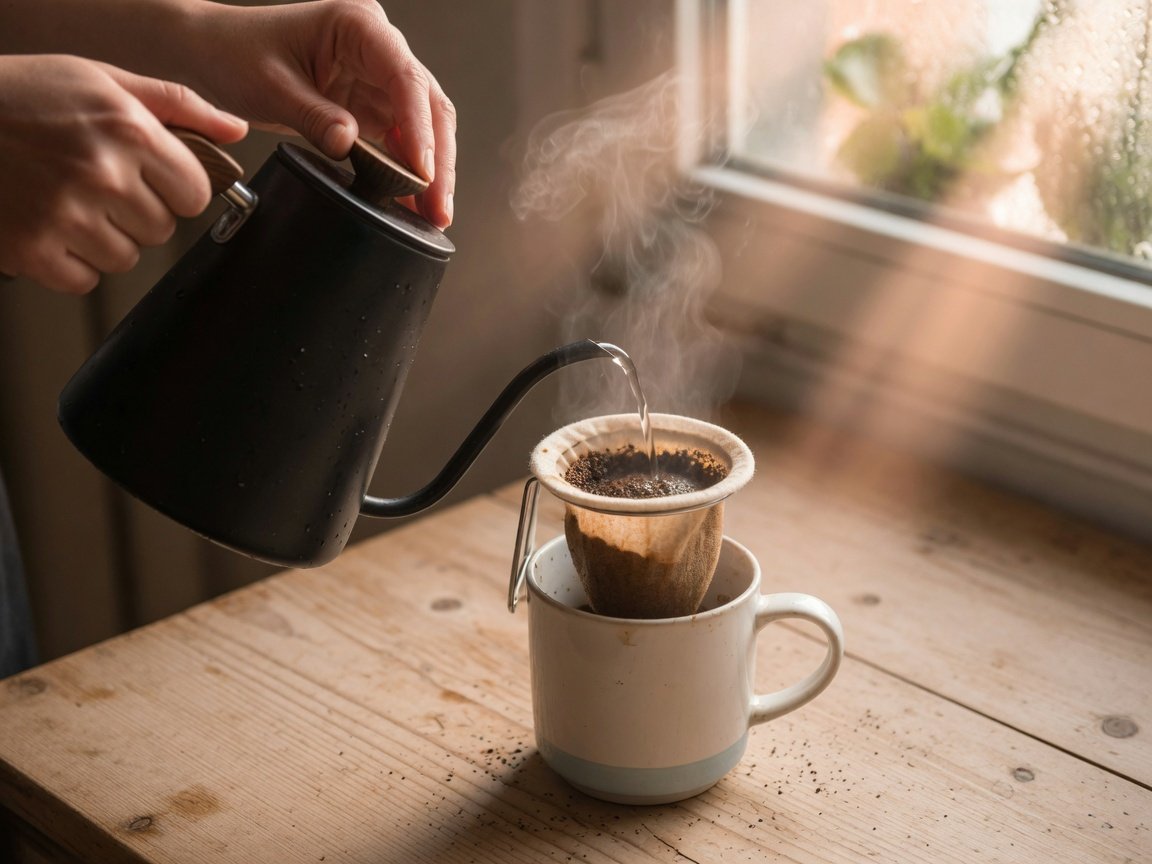
Pour-over coffee delivers a clean, bright cup because the water passes through the grounds once and drips through a filter. You don’t need a fancy ceramic dripper. A regular fine mesh strainer lined with a paper filter — or even a folded piece of clean cotton cloth — does the job well.
How to Make DIY Pour-Over Coffee
- Set your strainer or improvised filter over your mug.
- Add 2 tablespoons of medium-ground coffee to the filter.
- Pour just enough hot water to saturate the grounds — roughly 2 tablespoons — and wait 30 seconds. This is the “bloom.”
- Slowly pour the remaining hot water in a steady, circular motion over the grounds.
- Allow the coffee to drip fully through before removing the filter.
That 30-second bloom step is worth every second. When hot water first contacts fresh coffee grounds, trapped CO₂ escapes. Skip the bloom and pour everything at once, and that escaping gas disrupts extraction — producing an uneven, less flavourful result. Coffee professionals consistently list the bloom as one of the most underrated and most commonly skipped steps in home brewing.
Method 3: French Press — Rich and Full-Bodied Every Time
The French press is one of the world’s most popular manual brewing devices — and for good reason. The metal mesh plunger lets the natural oils from the coffee pass through into your mug, producing a rich, textured cup with far more body than paper-filtered methods allow. No electricity, no disposable pods.
Coffee author and World Barista Champion James Hoffmann has described the French press as one of the most under-appreciated home brewing tools available — primarily because most people use too fine a grind or steep too long, turning a great method into a bitter one.
How to Make French Press Coffee
- Add 2 tablespoons of coarsely ground coffee per 6 oz (180 ml) of water to the French press.
- Pour hot water (just off the boil) over the grounds and stir briefly.
- Place the lid on top without pressing down. Set a 4-minute timer.
- When the timer ends, press the plunger down slowly and evenly.
- Pour immediately — coffee left sitting in the press continues extracting and turns bitter.
For a deeper dive into getting the most from this brewing style, this beginner’s guide to French press brewing walks you through every variable — grind size, ratio, and timing — in full detail.
Manual brewing puts you in complete control of temperature, grind, and steep time — three variables that automated machines handle for you, often imprecisely.
Method 4: Cold Brew in a Mason Jar — No Heat Required
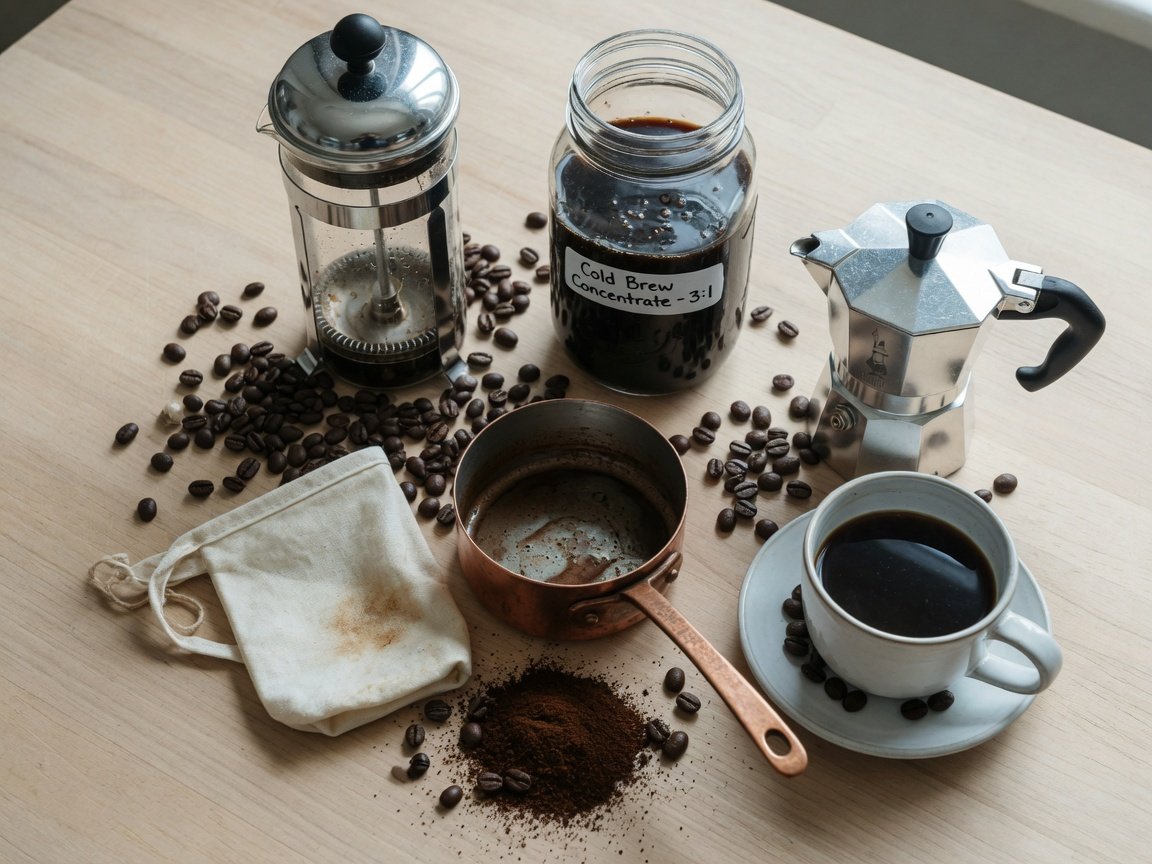
Cold brew is one of the most forgiving and practical methods for brewing coffee without a machine. You steep coarse grounds in cold water for 12 to 24 hours, filter, and serve over ice. No stove, no boiling water, no timing precision required — just patience.
Research shows that cold brew contains up to 67% less acidity than hot-brewed coffee. That lower acidity makes it smoother, naturally sweeter, and noticeably easier on sensitive stomachs — even without added sugar. It’s become one of the fastest-growing coffee formats globally, driven almost entirely by home brewers working with nothing more than a jar.
How to Make Cold Brew in a Mason Jar
- Add 1 cup of coarsely ground coffee to a large mason jar or pitcher.
- Pour in 4 cups of cold, filtered water.
- Stir to saturate all the grounds evenly.
- Seal the jar and refrigerate for 12–24 hours. Longer steeping produces a stronger concentrate.
- Strain through a fine mesh strainer lined with a paper filter or cheesecloth.
- Dilute the concentrate 1:1 with cold water or milk. Serve over ice.
The finished concentrate keeps in the fridge for up to two weeks — making cold brew one of the most practical everyday options for machine-free coffee drinkers. For more on steeping times, ratios, and serving ideas, this complete cold brew brewing guide covers everything you need.
Method 5: Turkish Coffee on the Stovetop
Turkish coffee is one of the oldest and most celebrated coffee traditions in the world. UNESCO recognised Turkish coffee culture as an Intangible Cultural Heritage in 2013, acknowledging its deep significance across the Middle East, the Balkans, and Central Asia. And you can make it authentically in any small saucepan — no ibrik or special equipment required.
How to Make Turkish Coffee on the Stovetop
- Combine 1 cup of cold water and 1–2 teaspoons of very finely ground coffee (almost powder-fine) in a small saucepan.
- Add sugar if desired and stir thoroughly before applying any heat.
- Heat over medium-low — do not stir once the mixture starts warming.
- Watch closely. A thick foam will form on the surface as the coffee heats. Just before it boils over, remove from heat immediately.
- Pour slowly into a small cup. Let the grounds settle for 1–2 minutes before drinking.
Turkish coffee is served unfiltered. The grounds settle naturally to the bottom. Drink until you reach them, then stop. To explore this method further — including how to recreate the characteristic foam without a traditional ibrik — this guide to making Turkish coffee without an ibrik walks through every step.
Method 6: The Coffee Bag Method — Simple as Making Tea
The coffee bag method works exactly as the name suggests. Fill a small cloth bag, a folded paper filter, or a mesh tea infuser with ground coffee, lower it into your mug, pour over hot water, and steep. It’s the most travel-friendly machine-free brewing method — and one of the easiest for anyone just starting out with manual brewing.
How to Use the Coffee Bag Method
- Fill a small cloth drawstring bag, a metal tea infuser, or a folded paper filter with 2 tablespoons of medium-ground coffee.
- Tie or seal it shut securely.
- Place the bag or infuser in your mug.
- Pour hot water (just off the boil) over and around it.
- Steep for 4–5 minutes, then remove the bag and enjoy.
Reusable cloth coffee bags are widely available at kitchen stores and are a genuinely eco-friendly swap for single-use plastic pods. Several specialty roasters now sell pre-filled coffee bags as a premium travel format — proof that this low-tech method has earned serious respect even among dedicated coffee drinkers.
Method 7: Stovetop Moka Pot — Espresso-Strong Without the Machine
The Moka pot is a stovetop brewer that uses steam pressure to push hot water through finely ground coffee, producing a small, concentrated, espresso-strength shot in around 5 minutes. No electricity, no capsules, no barista skills required.
Invented by Alfonso Bialetti in Italy in 1933, the Moka pot remains a fixture in homes across Europe and South America. More than 330 million units have been sold worldwide — remarkable evidence that a design nearly 100 years old still produces coffee people genuinely love.
How to Use a Stovetop Moka Pot
- Fill the bottom chamber with cold water up to the level of the safety valve — never above it.
- Insert the filter basket and fill with finely ground coffee. Level it off gently — don’t tamp it down as you would espresso.
- Screw the top chamber on firmly.
- Place on the stovetop over medium heat with the lid open so you can watch.
- When coffee stops flowing into the top chamber and gurgling slows, remove from heat immediately. Running the base under cold water stops extraction at the right moment.
Moka pot coffee is bold and concentrated. Drink it as a short, intense shot, or dilute with hot water for an Americano-style cup. Add frothed or steamed milk and you’re most of the way to a homemade cappuccino — no machine required.
How Do You Get the Coffee-to-Water Ratio Right?
The coffee-to-water ratio is the most important variable in manual brewing. Too much coffee and your cup is bitter and harsh. Too little and it tastes thin and watery — regardless of how carefully you followed every other step.
The Specialty Coffee Association’s Golden Ratio is a trusted starting point: roughly 1 gram of coffee per 15–18 grams of water. In practical kitchen terms, that’s about 2 tablespoons of coffee per 6 ounces (180 ml) of water. Adjust from there based on your taste and method. For a thorough breakdown by cup size and brewing style, this guide to how much coffee grounds per cup covers every scenario in detail.
| Method | Coffee | Water | Approx. Ratio |
|---|---|---|---|
| Cowboy Coffee | 2 tbsp | 8 oz | 1:16 |
| Pour-Over | 2 tbsp | 6 oz | 1:15 |
| French Press | 2 tbsp | 6 oz | 1:15 |
| Cold Brew | 1 cup | 4 cups | 1:4 (concentrate) |
| Turkish Coffee | 1–2 tsp | 2–3 oz | 1:7–1:10 |
| Coffee Bag | 2 tbsp | 6–8 oz | 1:15–1:16 |
| Moka Pot | Fill basket | Fill chamber | ~1:7 (espresso-strength) |
What Mistakes Should You Avoid When Brewing Without a Machine?
Even the simplest brewing methods have a handful of common pitfalls. Here’s what to watch for — and exactly how to fix each one.
1. Using Water That’s Too Hot
Boiling water at 212°F (100°C) scorches coffee grounds and pulls out harsh, bitter compounds. Let your water cool for 30 seconds off the boil before pouring. That small drop into the 195°F–205°F range makes a noticeable difference in cup quality. For the full science behind why temperature matters so much, this breakdown of ideal coffee brewing water temperatures explains it clearly.
2. Using the Wrong Grind Size
Grind size has a dramatic effect on flavour. Fine grounds over-extract quickly, producing bitterness. Coarse grounds under-extract, leaving you with a thin, weak cup. Rule of thumb: coarse for French press, cowboy coffee, and cold brew; medium for pour-over and the coffee bag method; fine or powder-fine for Turkish coffee and Moka pot.
3. Skipping the Bloom
In pour-over and similar filter methods, wetting the grounds for 30 seconds before the main pour lets trapped CO₂ escape first. Skip it and that gas disrupts the flow of water through the bed of grounds, creating uneven extraction. It takes 30 seconds and it’s always worth the effort.
4. Steeping for Too Long
Most hot-brew manual methods reach peak extraction at around 4–5 minutes. Beyond that, you’re pulling the bitter, astringent compounds you don’t want into your cup. Keep a timer nearby for French press and cowboy coffee — it removes all the guesswork.
5. Using Stale Coffee
No brewing method compensates for stale beans. Coffee that’s been sitting open in your pantry for weeks will taste flat and papery regardless of technique. Fresh, quality beans are the single biggest upgrade you can make to any cup — more impactful than any equipment or method change.
Frequently Asked Questions About Brewing Coffee Without a Machine
Can you make coffee without a machine or a filter?
Yes. Cowboy coffee is the clearest example — add coarse grounds directly to hot water, steep for 4 minutes, then pour slowly into your mug, leaving the grounds in the pan. Turkish coffee works the same way: unfiltered, with grounds settling naturally in the cup before you drink.
What is the easiest way to brew coffee without a machine?
The coffee bag method is the most beginner-friendly option. Fill a small cloth bag or tea infuser with coffee, place it in your mug, pour over hot water, steep for 4–5 minutes, and remove the bag. It’s genuinely as simple as making a cup of tea — and the results are consistently good.
Does coffee brewed without a machine taste different?
It often tastes better. Manual brewing gives you direct control over water temperature, steep time, and coffee-to-water ratio — variables that automated machines manage for you, often imprecisely. French press coffee, for example, retains the natural oils from the beans, producing a richer, fuller cup than most drip machines deliver.
What grind size should I use for machine-free brewing?
Match the grind to your method. Use a coarse grind for French press, cowboy coffee, and cold brew. Use a medium grind for pour-over and the coffee bag method. Use a fine or powder-fine grind for Turkish coffee and Moka pot. Using the wrong grind size is the most common reason machine-free coffee disappoints.
How long should coffee steep without a machine?
Steep times vary by method. French press and cowboy coffee: 4 minutes. Coffee bag: 4–5 minutes. Pour-over: no steep — it’s a continuous controlled pour. Turkish coffee: 1–2 minutes for grounds to settle in the cup. Cold brew: 12–24 hours in the refrigerator.
Is brewing coffee without a machine cheaper?
Significantly. A quality French press costs between $15 and $40 and can last for years with basic care. Cold brew requires only a mason jar and a filter. A Moka pot runs $20–$35 as a one-time investment. Compare that to pod machines where capsule costs often exceed $1 per cup — the savings accumulate fast.
How do I make coffee without electricity?
Several methods in this guide need zero electricity. Cowboy coffee and Turkish coffee both work over a campfire, gas burner, or any open flame. Cold brew requires nothing but time and a cool space. The coffee bag method works with hot water heated from any source at all — including a camp stove or a kettle on a wood fire.
Ready to Brew? Here’s Where to Start
Brewing coffee without a machine is less about compromise and more about discovery. Each of the seven methods in this guide produces a genuinely great cup — and some of them produce results that automatic machines simply can’t replicate.
Start with what you already have at home. Try cowboy coffee this weekend — you need nothing more than a saucepan and some grounds. Or start a cold brew tonight and wake up to a smooth, ready-to-pour concentrate in the morning. Once the basics feel natural, use the ratio table above to fine-tune your brew until the cup is exactly the way you like it.
The more attention you pay to what changes the flavour — and why — the better your coffee gets. Manual brewing rewards curiosity, and that’s a pretty enjoyable rabbit hole to fall into.
—