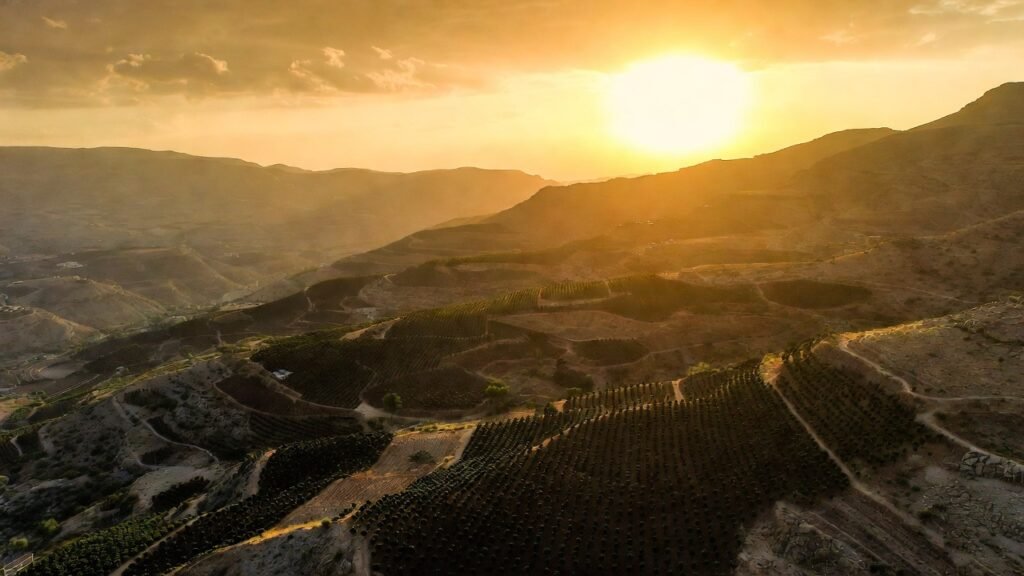
Yemeni coffee is the oldest cultivated coffee on Earth. It is the origin of every cup ever brewed. Grown on ancient stone terraces high in the Arabian Peninsula, it remains the rarest and most complex coffee available today — and in 2026, it is finally reaching more coffee lovers worldwide.
What You Need to Know: Key Facts
- Yemen is widely recognised as the birthplace of cultivated coffee, with documented trade dating back to the 15th century — making it the ancestor of every coffee-growing tradition on Earth.
- Top lots from regions like Haraaz, Mattari, and Ismaili regularly score above 88 SCA points, with exceptional harvests reaching 92-93 — placing them in the world’s elite specialty tier.
- The ongoing conflict in Yemen since 2015 has severely disrupted production, but small-scale exporters and social enterprises are actively rebuilding supply chains in 2025-2026.
- Buying authentic Yemeni coffee directly supports farming communities in one of the world’s most fragile economies — making every purchase a meaningful act of direct trade.
What Makes Yemeni Coffee Different From All Other Origins?
Yemeni coffee is unlike anything else in the specialty coffee world. The plants growing on Yemen’s mountain terraces today are direct descendants of the original coffee trees discovered in Ethiopia centuries ago — never hybridised, never commercially cross-bred. This genetic purity gives Yemeni coffee an unmatched flavour complexity that modern agricultural programmes simply cannot replicate.
Growing conditions play an equally decisive role. Yemeni coffee is cultivated at altitudes between 1,500 and 2,500 metres above sea level, in some of the most dramatic terrain on the planet. The extreme diurnal temperature variation — hot days and cool nights — slows cherry development and concentrates sugars and acids within the bean. The result is a cup profile unlike any other: deep, wine-like fruit, dark chocolate, tamarind, dried fig, and a lingering spice that specialty coffee buyers consistently describe as “ancient” in character.
Processing is equally distinctive. The vast majority of Yemeni coffee is naturally processed — cherries are dried whole on the fruit for three to six weeks in the mountain sun, allowing the sugars from the fruit to slowly ferment into the bean. This ancient method, practised long before the washed-process revolution, imparts a full-bodied, intensely fruited character that defines the Yemeni cup. Research in the specialty coffee industry indicates that natural processing preserves significantly more aromatic compounds than washed alternatives, contributing directly to Yemeni coffee’s extraordinary complexity.
What Is the Ancient History of Coffee in Yemen?
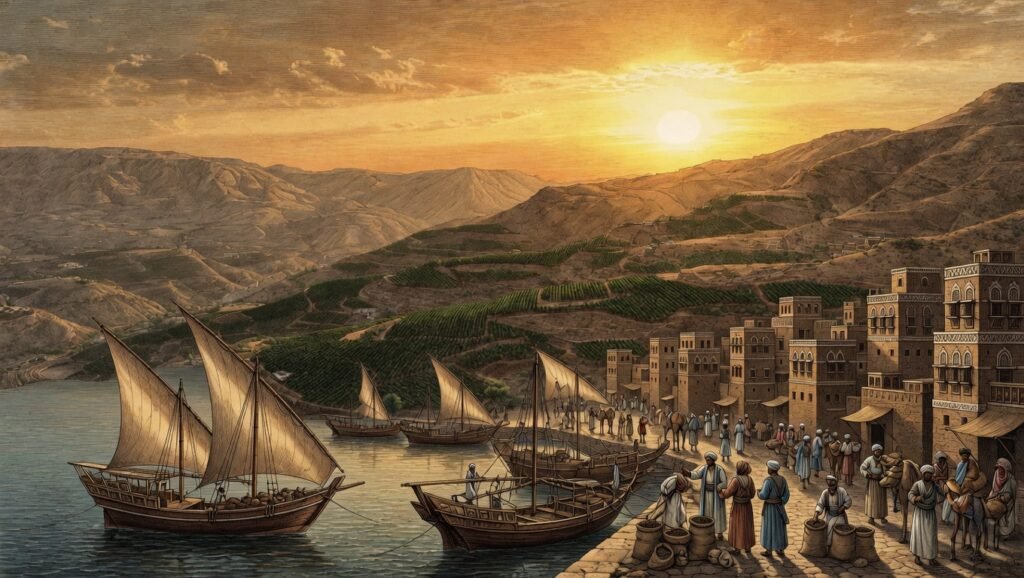
The history of coffee begins in Yemen. While wild coffee plants are indigenous to Ethiopia, it was Yemeni traders and Sufi monks who first cultivated coffee as a crop and transformed it into the global beverage we know today. Historical records indicate that by the early 15th century, Sufi mystics in Yemen were using a brewed coffee drink — known as qishr or qahwa — to sustain focus during long nights of prayer and devotion.
The port city of al-Mokha — from which the word “mocha” derives — became the world’s first great coffee trading hub. Throughout the 16th and 17th centuries, al-Mokha handled virtually all of the world’s coffee exports. Ships from across the Arabian Sea, the Indian Ocean, and eventually Europe anchored in its harbour to take on sacks of the precious commodity. Yemen held a near-monopoly on global coffee supply for well over a century.
That monopoly eventually ended when Dutch traders smuggled coffee plants out of Yemen in the late 1600s, establishing plantations in Java and Ceylon. But Yemen’s coffee identity never disappeared. Families continued to farm the same ancient varieties on the same mountain terraces, generation after generation, maintaining an unbroken agricultural lineage that no other coffee-growing country can claim. James Hoffmann, author of The World Atlas of Coffee, has described Yemeni coffee as one of the most historically significant agricultural products still in active production anywhere on Earth.
Where Exactly Is Yemeni Coffee Grown?
Yemeni coffee is grown almost exclusively in the western highlands — a mountainous interior belt running north to south through Sana’a, Haraz, and down toward the Taizz governorate. These areas receive seasonal monsoon rains that feed ancient hand-dug irrigation channels called aghraf, providing just enough water to sustain coffee plants through the dry season.
The farms themselves are unlike anything seen in modern coffee agriculture. Rather than large commercial estates, Yemeni coffee is grown on centuries-old stone terraces — hand-built agricultural structures carved into near-vertical mountain slopes. These terraces prevent erosion and retain moisture, creating micro-environments ideal for slow cherry development. Most farms are tiny by global standards, managed by individual families who harvest, process, and dry their crop entirely by hand.
Yemen is one of the world’s most water-stressed nations, with per-capita freshwater availability among the lowest globally. According to data cited by the UN Food and Agriculture Organisation, coffee competes with qat — a mildly narcotic shrub that uses significantly more water — for scarce irrigation resources. This water scarcity is a central structural constraint on Yemeni coffee production volume, and a key reason why supply remains so persistently limited year after year.
What Are the Main Yemeni Coffee Varieties and Regions?
Yemeni coffee is not a single product — it is a family of distinct regional varieties, each with its own flavour signature, altitude range, and processing tradition. Understanding these regions is essential to sourcing the right coffee for your palate and preferred brewing method.
| Region / Variety | Altitude | Flavour Profile | Rarity Level |
|---|---|---|---|
| Haraazi (Haraz) | 2,000-2,500m | Dark chocolate, dried cherry, tamarind, spice | Very High |
| Mattari | 1,800-2,200m | Winey fruit, blueberry, port, dark plum | Extremely High |
| Ismaili | 1,500-2,000m | Floral, apricot, medium body, lighter fruit | High |
| Sanani | 1,500-2,000m | Complex blend profile, chocolate, stone fruit | High |
| Hirazi | 1,800-2,300m | Raisin, molasses, tobacco, earthy complexity | Very High |
Mattari is widely considered the most prestigious Yemeni variety among specialty buyers, prized for its extraordinary wine-like character and deep fruit complexity. Haraazi is perhaps the most consistently available and offers the classic Yemeni cup profile — an excellent entry point for new buyers. Ismaili is often recommended for those who prefer lighter, more floral cups without the deep earthiness of higher-altitude lots.
Why Is Yemeni Coffee So Expensive?
Yemeni coffee is consistently among the most expensive in the world, and the reasons are structural — not speculative. Supply is genuinely tiny. Yemen accounts for well under 1% of global coffee production, and the fraction that meets specialty standards is smaller still.
Beyond raw scarcity, the supply chain is extraordinarily complex. Farms are remote and roads are often impassable. Export infrastructure has been severely damaged by years of conflict. Importers who work directly with Yemeni producers must navigate banking restrictions, port logistics, and quality consistency challenges that simply do not exist for coffee from Colombia, Brazil, or even Ethiopia. Each of these layers adds cost — and those costs are reflected honestly in the final retail price.
The global specialty coffee market was valued at approximately $47 billion in 2025, with premium single-origin coffees commanding growing price premiums as informed consumers increasingly seek rarer, more traceable origins. Retail prices for verified, quality-graded Yemeni lots typically range from $50 to $150 per 100 grams.
How Has the Conflict in Yemen Affected Coffee Farmers?
The war that began in 2015 has had a catastrophic impact on Yemen’s population and its agricultural heritage. Millions of people have been displaced. Infrastructure has been destroyed. Banking systems have been largely disrupted, making international payments to Yemeni farmers exceptionally difficult.
Despite these conditions, a remarkable community of entrepreneurs has worked to keep the coffee trade alive. Mokhtar Alkhanshali, whose story is documented in Dave Eggers’ book The Monk of Mokha, successfully evacuated Yemen during active shelling to export his first container of specialty coffee in 2015. His company, Port of Mokha, has since established direct relationships with farmers across several growing regions.
Research from development economists working in fragile-state agriculture suggests that premium coffee export income can provide farming households with earnings three to five times higher than subsistence grain farming. Other verified direct-trade importers, including Qima Coffee, have built similar ethical supply chains in 2025-2026.
How Do You Brew Yemeni Coffee for the Best Flavour?
Yemeni coffee rewards careful brewing. Its natural processing and high fruit complexity can produce extraordinary cups — or muddy, over-fermented results — depending entirely on how it is prepared.
Use filtered water at 90-93 degrees C
Yemeni coffee’s delicate fruit acids are volatile. Water above 96 degrees C risks destroying the very aromatic compounds that make it remarkable.
Grind medium-fine and always fresh
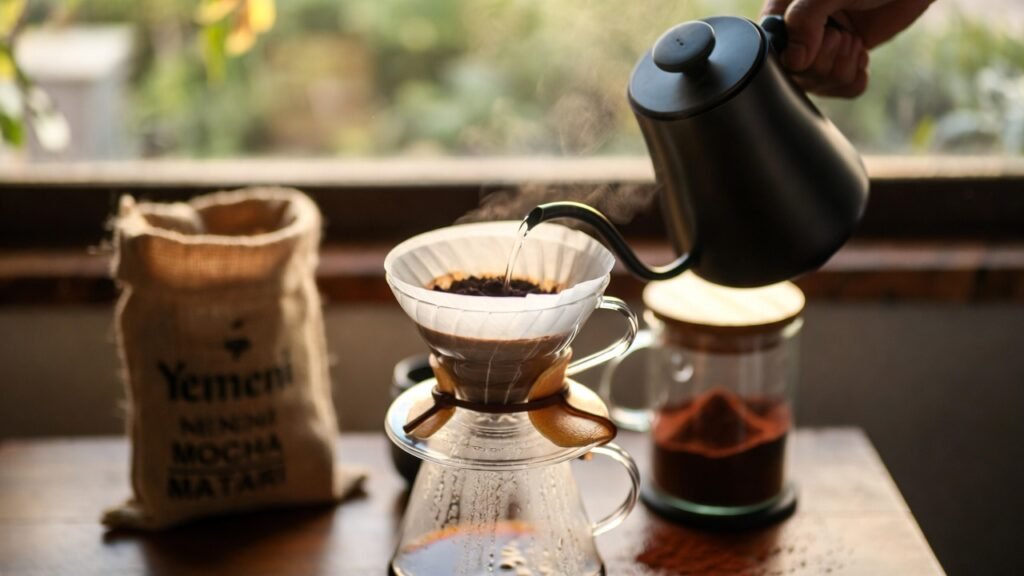
Grind immediately before brewing. Yemeni beans respond well to a medium-fine setting for pour-over, or medium for French press.
Use a 1:15 to 1:16 coffee-to-water ratio
Start with 15 grams of coffee to 225ml of water. The higher density of Yemeni beans often produces a fuller cup than you would expect at this ratio.
Allow a 45-second bloom
Pour twice the weight of water over the grounds and let them bloom for 45 seconds. This off-gasses CO2 and opens the grounds for even extraction.
Taste it black as it cools
Taste it black at around 65 degrees C, then again as the cup cools to 50 degrees — the flavour profile often transforms dramatically as temperature drops.
Try the traditional qishr preparation
Brew qishr: simmer coffee husks with fresh ginger, cardamom, and cinnamon for 10 minutes. This spiced husk tea was the original Yemeni coffee drink.
How Do You Source Authentic Yemeni Coffee in 2026?
Sourcing authentic Yemeni coffee requires more diligence than sourcing from most other origins. The combination of rarity and high prices creates significant incentive for mislabelling.
- Named producer or cooperative: Legitimate Yemeni coffee should be traceable to a named farm, village, or producer cooperative — not simply labelled “Yemen” or “Mocha” without further detail.
- Documented importer relationship: The roaster you buy from should be able to name their importer and confirm a direct trade relationship. Port of Mokha, Qima Coffee, and verified European importers are the most credible sources in 2026.
- Published cupping notes and lot scores: Genuine specialty Yemeni coffee should score above 85 SCA points; premium lots above 88.
- Recent harvest year on the label: Look for “2024/25 harvest” or “2025/26 harvest.” Old stock loses the fruit complexity that justifies the premium price.
- Honest, premium pricing: If a “Yemeni coffee” is priced similarly to an Ethiopian natural, it almost certainly is not what it claims to be.
How Does Yemeni Coffee Compare to Ethiopian Coffee?
Ethiopian and Yemeni coffees share a common genetic ancestor but centuries of divergence have produced two entirely distinct taste experiences.
| Factor | Yemeni Coffee | Ethiopian Coffee |
|---|---|---|
| Processing | Primarily natural (sun-dried, 3-6 weeks) | Both natural and washed widely available |
| Flavour profile | Dark fruit, wine, spice, chocolate, tamarind | Floral, citrus, berry (washed); jammy fruit (natural) |
| Body | Full, syrupy, heavy | Light to medium (washed); full (natural) |
| Acidity | Low to moderate, fruit-driven complexity | Bright and citric (washed); jammy (natural) |
| Genetic diversity | Extremely high — ancient unmodified landraces | Very high — wide variety of heirloom types |
| Global availability | Very limited | Widely available at all price points |
| Specialty price range | $50-$150 per 100g | $8-$40 per 100g |
Yemeni coffees tend toward darker, richer, more complex profiles: think tamarind, dried fig, dark chocolate, and port wine rather than fresh citrus or delicate flowers. For espresso, many specialty roasters consider Yemeni coffee extraordinary — delivering a depth in a concentrated shot that is nearly impossible to replicate with any other single origin.
What Are the 2026-2027 Trends in the Yemeni Coffee Market?
Despite persistent challenges, the Yemeni coffee sector is showing genuine momentum heading into 2026 and beyond.
- Expanding direct-trade networks: More specialty roasters in the US, UK, Australia, and Japan are building direct relationships with Yemeni producers, increasing the income share reaching farming families.
- Technology-assisted quality improvement: Several export operations have begun trialling optical sorting technology to reduce defect rates and improve lot consistency.
- Growing collector and enthusiast market: Verified micro-lots from top producers are selling out within hours of public release — creating strong demand signals for producers who meet quality benchmarks.
- Qishr and husk products as new revenue streams: Yemeni producers are beginning to market coffee husk (qishr / cascara) directly to international buyers, creating income from what was previously agricultural waste.
- Climate adaptation at altitude: Rising temperatures are beginning to affect cherry development timelines in lower-altitude areas. Farms above 2,000 metres are relatively protected, but adaptation will be an urgent priority through 2027.
The Bushy Beard Verdict: Why Yemeni Coffee Belongs in Every Serious Coffee Collection
Yemeni coffee is not just the world’s oldest origin — it is, for many specialty buyers, its most irreplaceable. The combination of ancient genetic diversity, extreme altitude, natural processing, and a supply chain built on extraordinary human determination produces a cup that no other country can replicate. If you are serious about understanding coffee at its deepest level, you need to taste Yemen.
{{IMAGE_4}}
Frequently Asked Questions About Yemeni Coffee
Is Yemeni coffee the same as mocha?
Yes — historically. The term “mocha” originally referred to coffee exported through the Yemeni port of al-Mokha. Today the word has been widely misappropriated to describe chocolate-flavoured drinks, but authentic Yemeni coffee — particularly from Mattari and Haraazi regions — is the original mocha. The chocolate and dark fruit notes in genuine Yemeni coffee are precisely what gave rise to the mocha flavour association.
How should I store Yemeni coffee at home?
Store in an airtight container away from light, heat, and moisture. Do not refrigerate — temperature cycling introduces condensation that degrades the bean’s aromatics. Consume whole beans within four to six weeks of the roast date. Buying in smaller quantities more frequently will almost always deliver a better cup than buying in bulk.
Does buying Yemeni coffee actually help farmers?
Yes — when bought through verified direct-trade importers. Organisations like Port of Mokha and Qima Coffee have documented, transparent supply chains that pay Yemeni farmers premiums well above commodity rates. The key is to buy from roasters who can name their importer and confirm a documented producer relationship.
What is the best brew method for Yemeni coffee?
Pour-over methods — particularly the V60, Chemex, or Kalita Wave — are the most popular, allowing fruit complexity and aroma to express fully. French press works well for those who prefer full body. Yemeni coffee also makes exceptional espresso, delivering a deeply complex, wine-forward shot. Traditional qishr preparation with ginger and cardamom is also highly recommended.
How do I know if my Yemeni coffee is authentic?
Look for named producer or region information, a published harvest year (2024/25 or 2025/26), a documented importer with a direct-trade relationship, and an SCA cupping score above 85. Authentic Yemeni specialty coffee retails for approximately $50-$150 per 100 grams. If substantially cheaper, treat with caution.
What does Yemeni coffee taste like?
Deep, wine-like fruit, dark chocolate, dried fig, tamarind, and lingering spice. Full-bodied and rich. Mattari tends toward port-like fruitiness; Haraazi toward dark chocolate and stone fruit; Ismaili toward lighter florals and apricot. Almost all Yemeni coffees share a distinctive earthy complexity — often described as “ancient” — that sets them apart from Ethiopian washed coffees.
How to Get Started With Yemeni Coffee: Your 2026 Action Plan
Yemeni coffee is the most historically significant, genetically unique, and arguably most flavourful coffee origin on Earth. Engaging with it thoughtfully is one of the most rewarding things any serious coffee lover can do in 2026.
- Week 1: Research verified Yemeni coffee importers and roasters. Start with Port of Mokha, Qima Coffee, or specialty roasters who publish full importer documentation.
- Week 2: Purchase 50-100g of a named Yemeni lot — Haraazi is a reliable entry point — from a roaster who can confirm the full supply chain.
- Week 3: Brew your first cup using a pour-over method with filtered water at 91 degrees C. Taste black as it cools and note the flavour evolution.
- Week 4: Compare a Yemeni natural side-by-side with an Ethiopian natural from Sidama or Harrar to understand what makes the Yemeni profile distinct.
- Month 2: Try a different regional variety — move from Haraazi to Mattari or Ismaili — to experience Yemen’s remarkable within-country diversity.
- Ongoing: Follow the harvest seasons. Yemeni coffee is typically harvested October through January. Fresh 2025/26 harvest lots should be available from mid-2026 onward.
Every cup of genuine Yemeni coffee connects you to six centuries of unbroken agricultural heritage — and delivers meaningful, direct support to farming families operating under some of the most challenging conditions on Earth. Start your Yemeni coffee journey with Bushy Beard Coffee today.