A beginner home barista needs 5–10 adjustment shots just to dial in a new bag of beans. An experienced one does the same in 3 shots or fewer. That gap — which only closes through weeks of deliberate daily practice — is what the home espresso learning curve actually looks like, and this guide breaks down every stage with real, sourced numbers.
- Dial-in shots: Beginners need 5–10 shots per session; experts do it in 3 or fewer — a 2–3× proficiency gap that only closes through daily practice (CoffeeGearHub, 2026)
- Time to consistency: Most home baristas pull reliably decent espresso within 2–4 weeks of daily practice; shot quality becomes reproducible after one month (Mastering Coffee, 2026)
- Bean waste: Expect to add roughly 25% to your bean budget in months 1–3 from dial-in and practice waste; this falls to +5–10% after six months (Complete Home Barista, 2026)
- True cost per drink: $0.65–$1.20 all-in versus $3–5 at a café — a 70–85% saving once the learning phase is behind you (Complete Home Barista, 2026)
What Does Dialling In Actually Mean for Home Baristas?
Dialling in is the process of adjusting your grinder and dose until a shot extracts within the right parameters. The standard target, documented in Mastering Coffee’s 2026 home barista guide, is 25–30 seconds at a 1:2 brew ratio — typically 18–20g of dry coffee producing 36–40g of liquid espresso in the cup. If a shot runs faster than 20 seconds, the grind is too coarse. Slower than 35 seconds, it’s too fine.
The complication is that every new bag of coffee behaves differently. Roast level, origin, freshness, and ambient humidity all change how coffee flows through the puck under pressure. A grind setting that produced a perfect shot on your last bag may underextract a new one from a different roaster. Even the same roaster’s beans can vary between harvest seasons.
This means dialling in isn’t a problem you solve once — it’s an ongoing calibration that happens with every fresh bag. For a full breakdown of every variable that goes into a balanced espresso shot, from grind size to extraction yield and tamp pressure, that guide lays out the complete picture before you start adjusting anything.
How Many Shots Does It Take to Dial In Espresso as a Beginner?
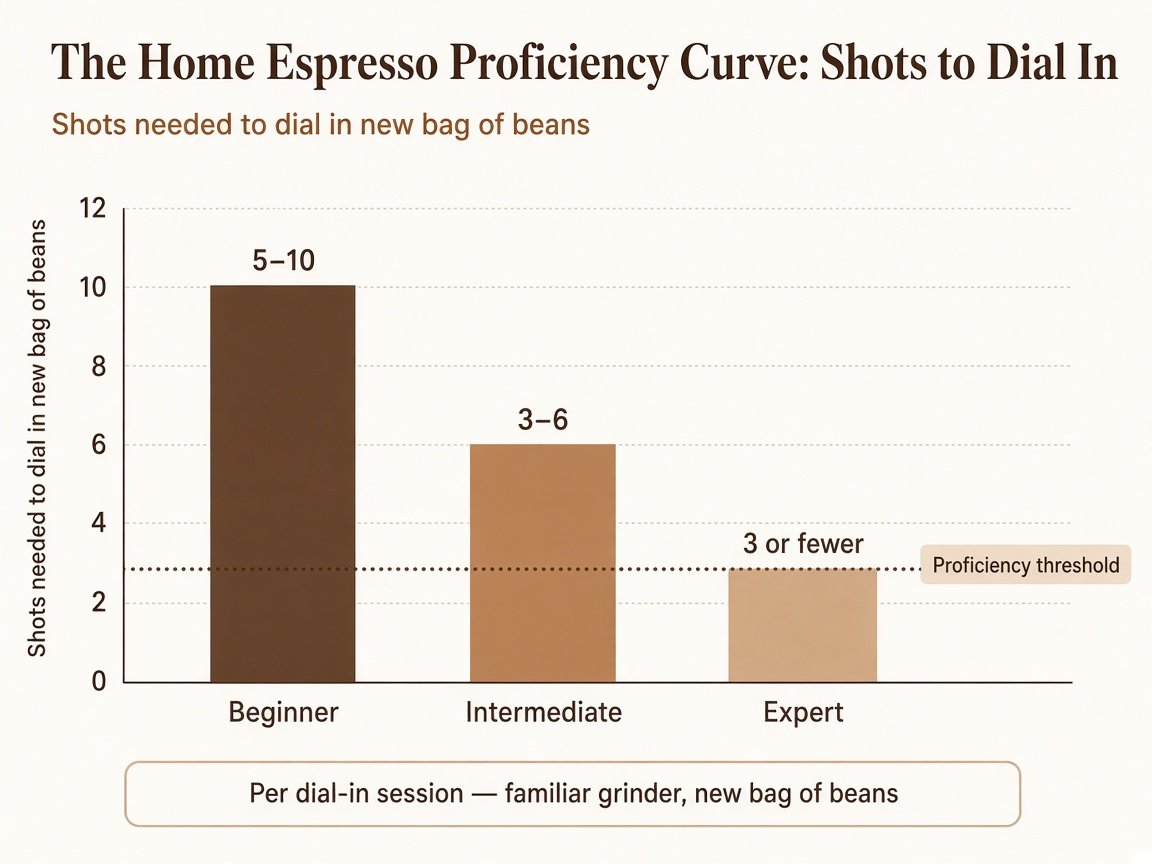
According to CoffeeGearHub’s 2026 dial-in guide, a beginner needs 5–10 adjustment shots to dial in a new bag in a single session. On a brand-new grinder with unfamiliar beans, the total can climb to 10–20 shots before the espresso is consistently balanced. As experience builds, those numbers drop sharply: a familiar grinder with a new bag typically takes 3–6 shots, and experts with 12 or more months of consistent practice can lock in a new bag in 3 shots or fewer.
The 2–3× proficiency gap comes down to one habit: changing only one variable at a time. Beginners commonly adjust grind size, dose, and tamp pressure simultaneously, which makes it impossible to identify what fixed the problem — or caused it. The Coffee Locator’s 2026 guide notes that after working through roughly five bags from the same roaster, home baristas develop a reliable starting-point grind setting that cuts dial-in shots on every subsequent purchase from that source.
Grinder quality matters enormously here. The right coffee grinder for espresso produces consistent grind particle distribution shot to shot, which removes one of the biggest sources of variability before you’ve even started adjusting anything else. Burr grinders outperform blade grinders for exactly this reason: the particle size is uniform, so the extraction behaves predictably.
What Happens During Your First Week Pulling Shots at Home?
Expect the first 20–30 shots of espresso to be undrinkable. Better Coffee Lab’s 2025 beginner espresso guide describes this as the standard experience — not a failure, and not a sign of a faulty machine. Sour shots, bitter shots, and channelled shots (where water finds the path of least resistance rather than flowing evenly through the puck) are all normal in this phase and are expected by anyone who has been through it.
Week one has one real goal: achieve a drinkable shot at all. Most beginners get there somewhere between shots 10 and 25, once the grind setting is in roughly the right ballpark and the tamp is becoming consistent. Pulling a genuinely pleasant shot — balanced acidity, some sweetness, no harsh bitterness — tends to happen later in that range, once the dial-in process has narrowed the variables down to a manageable starting point.
The best habit to build in week one is a simple shot log. Record your grind setting, dose in grams, and extraction time for every pull. This prevents the common trap of forgetting what you changed between shots and what actually fixed the last bad one. A notes app or a piece of paper next to the machine works perfectly. The goal of week one is a data point, not a perfect cappuccino.
A home barista starting with a medium-roast bean and a new entry-level grinder pulls their first shot well under 20 seconds — too fast, grind too coarse. After a finer grind adjustment, the shot runs within the 25–30 second target range: drinkable, a little sour, but in the zone. Next morning, the same setting pulls a few seconds long as the beans settle slightly. A minor tweak brings it back. This back-and-forth over 3–5 shots is the dial-in process in action. It is not a malfunction — it is the calibration cycle every home barista goes through.
How Much Coffee and Money Do You Actually Waste While Learning?
The numbers are significant. Beginners waste 20–30% of their coffee during the initial learning phase, according to Complete Home Barista’s 2026 hidden-costs guide. Each dial-in session uses 50–100g of coffee — roughly 3–5 shots at 18–20g each — just to find a usable grind setting before pulling a drink you’ll actually enjoy. For home baristas who switch to a new bag every week, that accumulates to 200–400g of wasted beans per month from dial-in shots alone, as reported by Cognoscenti Coffee Roasters in their 2025 espresso cost analysis.
The waste pattern across the learning arc is predictable. In months 1–3, expect to add roughly 25% to your bean budget from practice and dial-in waste combined. That drops to around 15% in months 4–6 as shots become more reliable, and falls to just 5–10% after six months as technique settles into something consistent. The encouraging part: the waste curve is steep in both directions. It rises fast in the first few weeks and falls just as fast once your shots start landing reliably.
At current specialty bean prices of $18–25 per 12oz bag, dial-in waste alone costs home baristas $50–100 per year on an ongoing basis, according to Cognoscenti Coffee Roasters (2025) — a recurring hidden cost on top of the initial learning phase. Once equipment amortisation, beans, milk, and water filtration are all accounted for alongside that waste, the true all-in cost per drink lands between $0.65 and $1.20, according to Complete Home Barista’s 2026 analysis. That compares to $3–5 at a coffee shop — a 70–85% saving per cup once the learning phase is behind you.
How Long Until Your Espresso Is Reliably Good?
Most people pull consistently decent espresso within 2–4 weeks of daily practice, according to Mastering Coffee’s 2026 home barista guide. “Consistently decent” means shots that are balanced and drinkable most mornings — not spectacular, but not sour or bitter either. After one full month of daily pulling, shot quality typically becomes reliably reproducible. You’ll know what your grinder’s sweet spot is for the beans you use most, and you’ll start pulling shots that taste similar to each other from one morning to the next.
Workflow speed follows its own timeline. After 2–3 weeks, Sweeter Grind’s 2026 espresso guide reports that the overall per-drink workflow compresses from roughly 10 minutes down to approximately 3 minutes as the steps become automatic. A complete flat white can be made in under 4 minutes once the machine is warm and the grind is already dialled in. That compression happens without any deliberate effort — it is a natural product of repetition.
Equipment matters for this trajectory. A well-chosen home espresso machine that heats consistently and pulls shots at stable pressure removes mechanical variability from the picture — which means every adjustment you make is actually answering a question about technique, not about hidden inconsistency in the hardware.
| Metric | Beginner | Intermediate | Expert |
|---|---|---|---|
| Shots to dial in a new bag | 5–10 | 3–6 | 3 or fewer |
| Time investment to reach this stage | Starting out | Approx. 1–3 months daily practice | 6–12 months daily practice |
| Added bean waste vs baseline | +25% (months 1–3) | +15% (months 4–6) | +5–10% (after 6 months) |
| Workflow time per drink | ~10 minutes | Improving rapidly (compresses after 2–3 weeks of daily practice) | ~3 minutes |
| Shot-to-shot consistency | Unpredictable | Building | Reliable |
Why Is Home Espresso So Much Harder Than Every Other Brew Method?
Espresso sits at the intersection of multiple variables that all interact with each other at once. Grind size, dose weight, extraction time, water temperature, tamp pressure, and bean freshness all affect the final shot — and each one affects the others too. Change the grind and the extraction time changes. Adjust the dose and you need to re-verify the extraction time. Use beans that are slightly over-rested for your machine and even a previously locked-in setting will produce a different result.
Compare this to a French press or an AeroPress, where the margin for error is significantly wider and variables interact less aggressively. Espresso is unforgiving by design — the small dose and high extraction pressure amplify every variable. A grind that is fractionally too coarse produces a sour, underextracted shot. A grind fractionally too fine produces a bitter, overextracted one. The window between them is narrow, and it shifts with every new bag of beans.
This is why home espresso machine reliability matters as much as technique. A machine with inconsistent boiler temperature or pump pressure introduces mechanical variables on top of the ones you’re already managing — meaning you can do everything right and still get an inconsistent shot. Eliminating equipment variability first means your adjustments are always answering a real question about technique, not a hidden question about the hardware.
How Do You Actually Speed Up the Home Espresso Learning Curve?
There is no shortcut past putting in the reps. But there are practices that make each rep more valuable. These are the habits that consistently separate home baristas who plateau after six months from those who click into genuine competence by month three.
- Keep a shot log. Record grind setting, dose in grams, yield in grams, and extraction time for every pull. Patterns only emerge from data, and you will not reliably remember what you changed three shots ago.
- Change one variable at a time. If a shot runs in under 20 seconds, adjust grind only. Wait for the result before touching dose, tamp, or temperature. This is the single most important rule.
- Stick with one roaster for your first three months. After working through roughly five bags from the same source, you will have a reliable starting-point grind setting, according to The Coffee Locator’s 2026 guide. Each new bag from that roaster needs fewer adjustment shots because you have a history to reference.
- Weigh your dose and your yield. Eyeballing either one adds a variable you cannot control for. A digital scale accurate to 0.1g is the cheapest accuracy upgrade available and removes two variables from every session.
- Time every shot. The 25–30 second target from Mastering Coffee’s 2026 guide is your anchor point. If you are outside that window, the fix is a grind adjustment — not a dose change, not a tamp change, not a temperature change.
- Watch your caffeine intake on dial-in days. Multiple test shots stack up faster than most people expect. Plan accordingly and consider discarding rather than consuming every adjustment pull.
The Short Tool List
You do not need expensive accessories to practise well. The four things that make dial-in sessions genuinely data-driven rather than guesswork are: a digital kitchen scale accurate to 0.1g for weighing dose and yield; a timer — a phone timer works perfectly — for every shot; a shot log in any format you will actually maintain; and a note of the specific grind setting used for each session so you can return to a known starting point with the same beans rather than starting from scratch each time.
On active dial-in mornings, home baristas pulling multiple test shots can consume 600–800mg of caffeine — well above the 400mg daily limit recommended by health guidelines. Drink water between pulls, and strongly consider discarding rather than consuming each adjustment shot. Source: Cognoscenti Coffee Roasters (2025).
When Does Latte Art Come Into the Picture?
Latte art is a late-stage skill, and treating it as a beginner milestone will only add frustration to an already steep curve. According to Mastering Coffee’s 2026 home barista guide, the first 50 milk-steaming attempts will produce poor results. Recognisable patterns — hearts, rosettas, and tulips — typically emerge only after 2–3 months of consistent milk-steaming practice. That is not a pessimistic forecast. It is an accurate one.
The microfoam texture that allows latte art to form depends on a technique that takes genuine repetition to develop: the right steam wand angle, the right rotation speed, and the right depth below the milk surface. The hands learn it before the head does. No amount of watching videos replaces the reps.
A more useful early milestone is a consistent flat white: textured microfoam that integrates cleanly with the espresso without breaking or separating on the surface. If you can do that, you are building the foundation latte art sits on. The visual patterns come once the texture is reliable. If you are still in the early weeks and focused on getting a balanced shot before worrying about milk, this step-by-step guide to making espresso at home walks through the progression from first pull to milk-based drinks at a manageable pace.
What Does Full Bean Mastery Actually Look Like?
Full bean mastery — the ability to adjust technique confidently for different origins, roast levels, and seasonal crop variations — typically develops over 6–12 months of regular home espresso brewing, according to Mastering Coffee’s 2026 guide. This is the stage where dialling in stops feeling like troubleshooting and starts feeling like calibration. You are not fighting the variables anymore; you are managing them intentionally.
Alongside shot technique, more advanced workflow skills develop during this period: pressure profiling, water chemistry adjustments, and an understanding of how freshness affects different bean types. These are the variables that separate a competent home barista from a genuinely skilled one. This level of engagement with the craft is increasingly common among home coffee enthusiasts.
The 2026 National Coffee Data Trends report from the NCA and SCA puts this appetite in a wider context: specialty coffee past-day consumption reached 47% of US adults in 2026, surpassing traditional coffee (at 42%) for the first time, with espresso-based beverages accounting for 45% of past-week consumption — record highs for both. The audience for quality home espresso has never been larger. For those who want to take the obsession even further, home coffee roasting offers a parallel learning arc — with its own version of the dial-in curve, but at the source rather than the machine.
Is Home Espresso Worth the Time and the Wasted Beans?
The economics work strongly in favour of home espresso — once you are past the learning phase. At $0.65–$1.20 per drink all-in versus $3–5 at a coffee shop, the per-cup saving runs 70–85%, according to Complete Home Barista’s 2026 analysis. A $500 home setup pays for itself in roughly four months for someone who would otherwise buy a daily café coffee. The long-term value proposition is clear.
The time cost is real and often undersold. A full daily home espresso routine — machine warm-up at 10–20 minutes, dial-in and pulling at 10–15 minutes, and cleaning at 5–10 minutes — runs 25–45 minutes total, adding up to 3–4 hours per week for a dedicated home barista, according to Cognoscenti Coffee Roasters (2025). That time compresses significantly after the first month as steps become automatic, but the warm-up and cleaning routines never disappear entirely.
The 5× growth in demand for professional barista classes — documented by The Boston Globe in February 2026, with one Boston-area school growing from two classes per month to multiple sessions every week in just 2.5 years, with $125-per-session classes booking weeks ahead — suggests that the difficulty of home espresso is actually increasing people’s appetite for deeper learning, not driving them away. The honest answer to whether it is worth it comes down to how you feel about the process. If the ritual and craft are part of the draw, the learning curve is a feature. If you just want a fast and reliable cup, the first few weeks of consistent shot failures are real and worth knowing about before you commit.
Frequently Asked Questions
How many shots does it take to dial in espresso as a beginner?
Beginners typically need 5–10 adjustment shots to dial in a new bag of beans in a single session. On a brand-new grinder with unfamiliar beans, the total can reach 10–20 shots before the espresso is consistently balanced. Experienced home baristas reduce this to 3–6 shots per session, and experts can lock in a new bag in 3 shots or fewer. If you are still off after eight shots, you are likely changing too many variables at once — one adjustment at a time is the key rule.
How long does it take to learn to make good espresso at home?
Most people pull consistently decent shots within 2–4 weeks of daily practice. The first week focuses on achieving a drinkable shot at all; by month one, shot quality becomes reliably reproducible. Workflow compresses to around 3 minutes per drink after 2–3 weeks of practice. Latte art takes 2–3 months before patterns look recognisable — the first 50 steaming attempts will look poor. Full bean mastery — adjusting confidently for different origins, roast levels, and seasonal variations — develops over 6–12 months.
How much coffee do you waste learning home espresso?
Beginners waste 20–30% of their coffee during the initial learning phase. In the first three months, expect to add roughly 25% to your bean budget from dial-in and practice waste — this drops to +15% in months 4–6 and +5–10% after six months. Each dial-in session uses 50–100g of coffee (3–5 shots at approximately 18–20g each); home baristas who switch beans weekly accumulate 200–400g of wasted beans per month from dial-in shots alone. At current specialty prices of $18–25 per 12oz bag, dial-in waste alone costs $50–100 per year as an ongoing recurring expense.
Is home espresso worth the time and effort?
The all-in cost per home espresso drink — including equipment amortisation, learning waste, beans, and milk — is $0.65–$1.20, versus $3–5 at a coffee shop, saving 70–85% per cup. A $500 home setup pays back in roughly four months for a daily café-coffee drinker. The main trade-off is time: a full daily routine runs 25–45 minutes including warm-up and cleaning, or around 3–4 hours per week. The first few weeks involve consistent shot failures while technique develops — which is worth knowing before committing.
Why is dialling in espresso so hard for beginners?
Espresso involves multiple interacting variables — grind size, dose, extraction time, water temperature, and tamp pressure — all of which must be calibrated at once. Research consistently confirms that consistent grind particle distribution is one of the main drivers of extraction consistency, which is why even skilled home baristas need 3–4 shots to confirm a new bag is dialled in. Beginners who adjust multiple variables at once make the process significantly harder than it needs to be. The single most important rule: change only one variable per shot until the espresso is balanced.
Where to Go from Here
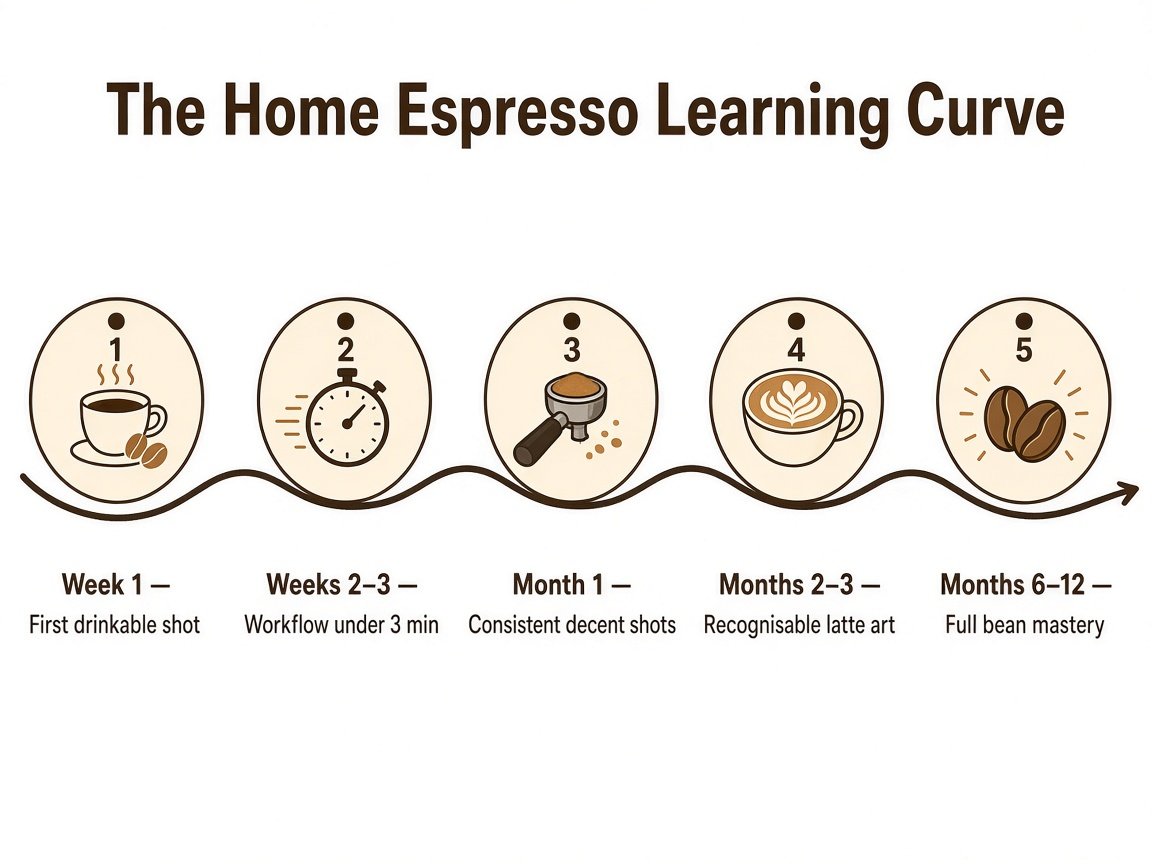
The home espresso learning curve is predictable once you know what to expect at each stage. Here is the realistic progression — and what to focus on at each point:
- Week 1: Accept that the first 20–30 shots will be undrinkable. Focus on pulling consistently, not pulling well. Build the shot log habit from day one — it is the single most useful thing you can do in this phase.
- Weeks 2–3: Work on one variable at a time. Your workflow will compress from roughly 10 minutes to around 3 minutes per drink as the routine becomes automatic. This happens without any deliberate effort — it is a natural product of repetition.
- Month 1: Shot quality becomes reliably reproducible. You are past the worst of the waste phase and into the building phase. The added bean cost drops from +25% toward +15%.
- Months 2–3: Latte art starts to look recognisable after 50 or more steaming attempts. Bean waste continues falling. This is when home espresso starts to feel genuinely rewarding rather than just educational.
- Months 6–12: Full bean mastery. Dial-in waste settles at +5–10%. You are adjusting technique for origins and roast levels, not just trying to get a balanced shot. Advanced skills like pressure profiling and water chemistry come into focus.
Looking at the next 12–24 months, the data points one direction. The 2026 NCA/SCA report shows specialty coffee past-day consumption surpassing traditional coffee for the first time, and espresso-based beverages at record consumption highs. The demand for professional barista training has grown 5× in 2.5 years. These trends suggest that the bar for what “good home espresso” means will keep rising — and the home baristas who invest in mastering the dial-in process now will be ahead of a curve that is only becoming more demanding for latecomers.
The wasted beans and time investment in the early weeks are not a problem to solve. They are the cost of admission for a skill that will save you 70–85% per drink for the rest of your coffee-drinking life. The only thing that shortens the curve is daily practice and the discipline to change one variable at a time.
— **Schema Markup (shown separately for reference):** Embedded above in the article body as a JSON-LD block covering Article, FAQPage, and HowTo schema types.